(All the words followed by * are explained in the glossary at the end of this article)
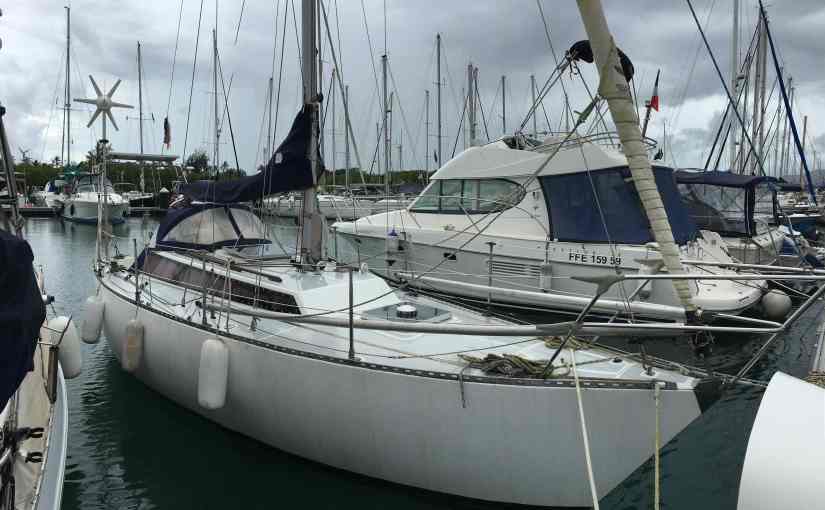
Nautigirl is mine. Before moving in, I spend 3 days cleaning her from top to bottom : the second last owner had scattered anti-cockroach powder everywhere and Frédéric, the last buyer, never got rid of it. It’s everywhere in the boat… Except if he got involved in a trafficking of cocaine from Saint Lucia(*) ending up in some kind of snowball fight aboard which I seriously doubt… This chemical substance seems really effective because I see no trace of a living insect. Given the large quantity of powder I find in the storage compartments, even in the seat cushions seams, I am sure the cockroaches were not the only ones to die.
After having vacuumed most of it, I delicately try to remove the rest of it with a sponge, hands protected with gloves, trying not to inadvertently inhale anything. Some places are simply inaccessible and I eventually give up the idea of removing all tracks of this product. It is here for too long and here and there, it seems stuck on the resin itself. I do my best and, well, if there is still a little, it is even better, it will put off cockroaches wanting to test their luck aboard.
The spring cleaning of the boat is now finished. This required no advanced knowledge so that was easy for me… Now, the question is : how am I going to move her ? The marina authorized me to stay here till the end of the month because, even if Frédéric had sold his boat, they would not retrocede him a share of the monthly rent he had paid, and he generously didn’t ask me to pay anything for it. I have to move the boat the day after tomorrow and for now, I still do not know how I will do it.
I may have recently got my deep-sea licence(*) – 1 month before my Transatlantic – because I wanted to know more about boats, but I learnt nothing about sailing really, I just learnt how to create a route or to take a bearing(*), and I had a 20 out of 20 ! That is again my « perfect student » side who thinks there is certificate for everything… Well, regarding sailing, there is no substitute for experience… It’s one thing to cross the Atlantic on a big vessel (a Sun Odyssey 479) with a crew and a skipper abord and it’s another thing to be by yourself aboard your own boat.
I have never done any manoeuvres in port, I have seen the engine being started only once and it is a little bit more complicated than just turning the starter key, I do not know how the autopilot(*) is working and I have no clue about how you deal with a boat and the sails all together when you have no crew to help… I need an operating manual instructions or rather, as I have done to learn how to drive a car, I think I need an accompanied practice to gain self-confidence and to get to know my boat. And indeed, I think of someone owning Nautigirl’s twin and who could help me. It is Pierre, that buddy who abruptly abandoned me on my way to meet Frédéric at the marina when we were supposed to go together to this appointment… It has been a few days now, maybe he will be in a better mood…
I call Pierre to know if he is willing to help me. It seems he is not such a bad guy as he answers positively to my request. Though, I should stipulate that I offered to pay him for his time and the knowledge he is willing to share with me. This has been a good motivating factor, for sure. In truth, as he has no job yet, it suits him fine even if he will not admit it…
I pick him up in Anses d’Arlets, an hour’s drive from marina Z’Abricots and comes back with him to the boat. He inspects scrupulously my new purchase. He is calling me a fool for having bought her on a whim in spite of my lack of expertise. He is turning a deaf ear when I remember him that I had first planned to have guidance from a specialist. I put an end to the discussion asking : « Well, it is done now, so : how do you find my boat ? ».
He comments everything looking suspicious to him. He checks the good condition of the rigging(*), he looks up at the mast and ensures it is straight, he looks closely to the shrouds(*). Not a word. Then he puts one hand on a winch(*) trying to make it twist. Nothing… It is stuck. Like all the others in fact… Well, I haven’t given the slightest thought to checking that. Frédéric had told me that he sailed on a regular basis, it is why I supposed that the winches worked well. How did he manage to tighten the genoa(*) or hoist(*) the mainsail(*) otherwise ? On second thought, it looks like he didn’t spend so much time learning how to sail or he quitted a while ago…
Then, Pierre checks the state of halyards(*) and sheets(*) as well as the state of the stanchions(*) feet, the toe rail(*) and the guardrail(*). Afterwards, he stands a minute on the saloon steps(*) detailing the inside of the boat before stepping in. He lifts the steps bringing the engine into view. He stares at it silently, checks the level of oil and its aspect, starts it for a few minutes, listens and then switchs it of.
He flips up the different parts of the floor, another thing I didn’t think of and he exclaims : « The bolts of the keel(*) ! They are hidden ! ». Exact… We see only big bumps covered with resin and white paint. I wonder aloud : « Ha ? And this is important ? » Right away, he lectures me telling me how important are theses bolts because they are the ones maintaining the keel attached to the hull. It is why it is so important to check on them on a regular basis. They should not be hidden. He thinks it could be a trick played by the previous owner to hide the poor condition of theses bolts. I already figure my boat suddenly losing her keel while sailing. So that’s it ? Simple screws holding the whole keel ? I thought… I don’t know… I thought it was welded or glued or whatever but not simply screwed… Pierre would almost make me think I have been tricked ! I quickly call Frédéric for explanations. He tells me that the table – in the center of the boat – is not the original one. When it was set up, its two feet were close to the keel bolts and to make it look nice and clean, it was decided to put resin on both the feet and the bolts. That’s all. After him, theses bolts are in a perfect condition. « Ah ? Ok… ». I can only trust him, otherwise I should remove the thick layer of resin to reveal the top of bolts. Not easy to verify such statements, hummm … I will see that point later …
I turn to Pierre : « And apart from that ? Huh ? Of course, there are points to be checked, but still, I did not buy a ruin? Yes ? », « No ? Haaa, that’s a great news !!! ». I can tell by his funny face that he considers that it could have been worse, that I had only been lucky, so I should better not gloat … In his opinion, he would have seen at once what is wrong and he would have negotiate harshly the price… According to me, though, I think that if I had tried to negotiate, the next visitor would have paid cash the exact amount and today, I wouldn’t own Nautigirl. It is clear we have strong difficulties to have our sights set. It is promising for the future…
He finishes the inspection of the boat and then he starts to raise a list of things to buy to work on her. For now, indeed, I own no tool. I have just arrived from my Transatlantic with my backpack and my kite and these are all my belongings. The only tool I found on board, it is a 12 volts drill/driver.
The most fortunate buyers of a boat find on board a complete toolkit, when others have to make one from scratch. Thus, we go shopping in different hardware stores. I need a set of screwdrivers of various sizes and imprints, a hacksaw, a cutter and blades, several buckets (buckets are always useful on a boat), spanners, Allen wrenches, various drills and imprints for the driller, a hammer etc. In brief, I spend a fortune to have a minimum of tools on board and become a fresh handywoman. This is a detail I paid no attention to when I bought Nautigirl : when you buy a boat and that the previous owner leave on board some equipment, this represents a considerable economy.
This reasoning applies to the dishes. To live on board, you need cutlery, plates, glasses, bowls, pans etc. and again, there was none on Nautigirl… It is a new hard blow for my purse… Oh no, I forgot : I found on board 4 purple plastic cups and a set of small yellow disposable plates… And a big bag of chips and a bottle of water ! Yahooo !!! In brief, it is not luxury aboard and I end up this costy day in a supermarket to buy dishes and food in order to be able to cook a meal on Nautigirl.
The following day, I come back to the boat with Pierre. I have already taken the time to tidy up all the tools inside. I am impatient to start my training : « Boat maintenance ».
First step : to dismantle all the winches which are all jammed. Pierre shows me how to clean the first one. He disassembles it completely taking care of putting all the different parts in a small basin. The bulk of the operation is not to lose any of them. And he teaches me that, being on a boat, the trick is to always use a bowl or something to store anything being dismantled to avoid losing it in the water. I stand and watch him et then I repeat his way on another winch. It is almost a Meccano construction game. You just need to know which part goes where. When everything is dismantled, we clean everything with diesel. We brush, we rub to remove dirt and old grease which are everywhere preventing the winches from working. Then we spray some WD 40, this magic product, some clean grease and hop ! we mount back the winch and miracle, it turns !!! A few hours later, all of them work. A first problem solved ! I manage not to lose anything even if I had a small fright, I should admit, when a small spring sprang from its location to fall inside the boat and not in the water. I have been lucky this time because the company which factored my winches does not exist any more and I have no way to find spare parts.
Second step : to do the routine maintenance of the engine. I have no clue about when the last draining and the change of the filters have been done. All I know is that Frédéric, the previous owner, has done nothing in 6 months of ownership so it could be a while. Thus, Pierre shows me how to do the oil draining giving me some few tips at the same time to work without making a mess. For example, to cut a plastic bottle of water in its length which will fit under the draining screw to collect the old oil. He tells me the usefulness of baby diapers which are hyper absorbent and perfect to clean any oil running. Funny… I would have never thought that a baby diaper could be useful on a ship only if you have a baby… I film eveything he shows me in case I forget any detail when I will have to do it again by myself. Having removed the oil filter, he goes on with the circuit of diesel and dismantles the filter and the prefilter. The following morning, I run to buy the new filters from a shipchandler(*) and I combe back to Pierre my bag loaded with my purchases. He begins to put everything together while going on with more explanations. Then we check all the levels : oil, diesel and cooling liquid. While doing it, he reminds me all the steps to follow before starting the engine : seawater inlet valve opened, throttle control in neutral, switch number 1 on « on », switch number 2 on « preheating » hanging on for about 15 seconds and then « start ». The engine coughs and runs smoothly. Everything is fine, he hums as an old grandpa. At the back of the boat, I check that its spits water, sign that the engine is well cooled by the sea water.
Everything is fine for the departure tomorrow morning !
Want to follow me on Instagram ? Easy ! My profile is dreamchaser_and_nautigirl.
See you soon !
PS : This story is real but names in the article have been changed to protect anonymity except prior express permission.
GLOSSARY :
Autopilot : as you can guess, it is comme son nom l’indique, it is a mechanism which allows to pilot a boat with no human intervention. Very helpful when you do not want to steer yourself !
Bearing : taking a bearing is measuring the angle under which you see something (a lighthouse, another boat etc.) compared to reference direction which is the North.
Companion way : it is the entrance to the inside of the boat.
Deep-sea licence : this licence authorizes to drive engine powered boats with no power limitation, nor size and you are free to go further than 6 nautical miles from a shelter. For your information, no licence is needed for a sailing vessel.
Genoa : front sail overlapping the mainsail.
Guardrails : cables, usually made of steel, running all around the boat’s deck through the stanchions and being part of the rail.
Halyard : “rope” you see hanging along the mast allowing to raise or lower a sail.
Hoist (to) : to raise a sail by means of ropes and pulleys.
Keel : kind of « ventral fin » you see under the boat’s hull used as a daggerboard. Weighted, it lowers the vessel’s centre of gravity, offering improved stability.
Mainsail : main sail of the boat all the way up the mast.
Rigging : apparatus through which the force of the wind is used to propel sailboats and sailing ships forward.
Saint-Lucia : it is an island nation in the south of Martinique.
Saloon steps : they give access to the companion way(*).
Sheet : “rope” tied to a sail allowing to adjust its angle compared to the wind (by easing or tightening it).
Shipchandler : store specialized in boat’s parts.
Shroud : pieces of standing rigging which hold the mast up from side to side.
Stanchions : vertical metal bars surrounding the vessel’s deck and in which the guardrails go through.
Toe rail : narrow strip which runs along the edges of a boat’s deck preventing, for example, feet from sliding overboard.
 DreamChaser & Nautigirl